Thursday, October 15, 2015

Nimona: A Review

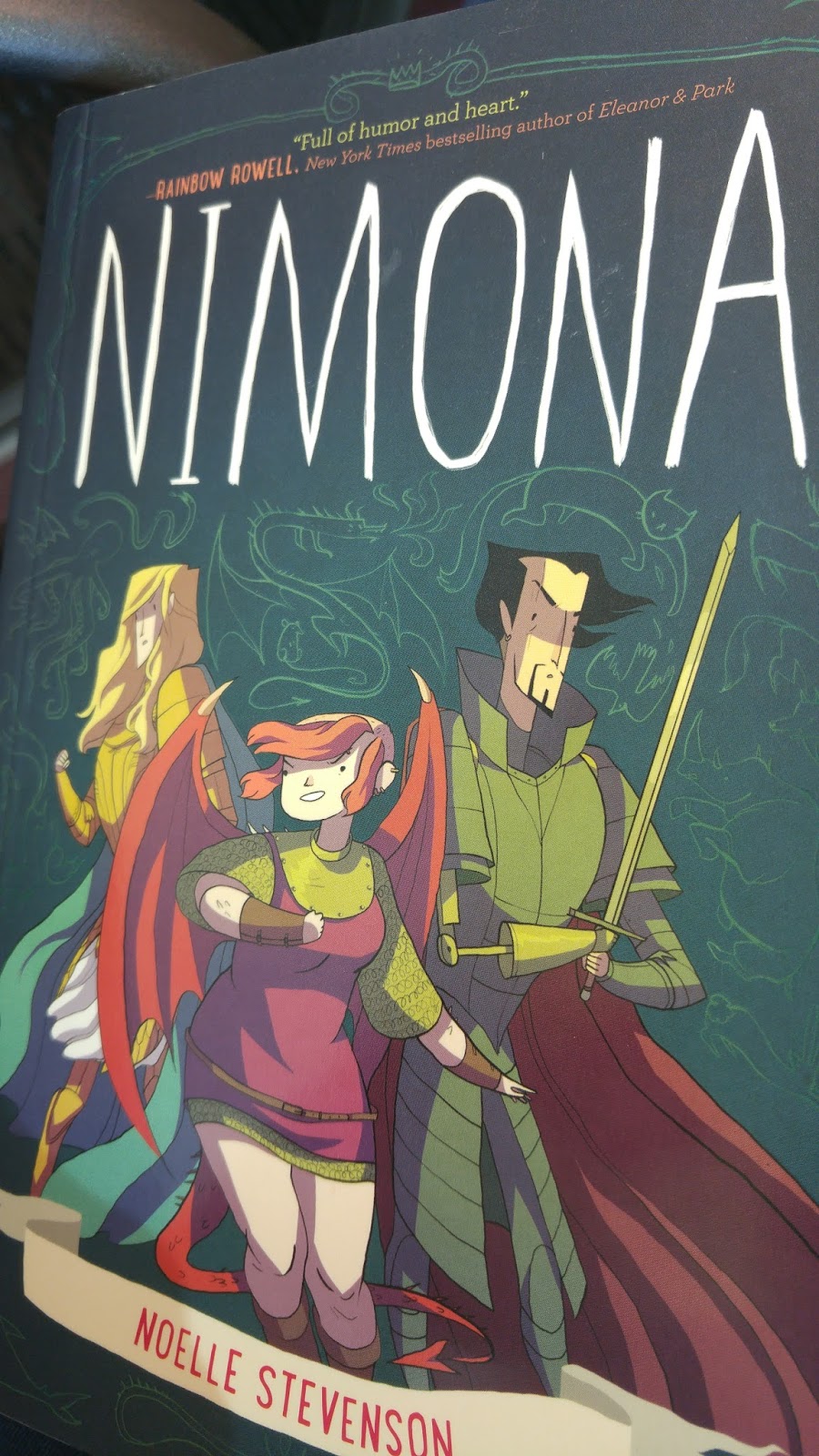
Nimona graphic novelI grew up thinking of cartoons as the tempting but sinful fruit that kept my neighborhood friends inside when I wanted them to be outside playing. As I grew older, various friends tried to point out the merits of cartoons, video games, graphic novels and the like. I persisted in my disregard for such genres, even after professors assigned award-winning graphic novels like Spiegelman’s Maus and Gene LuenYang’s American-Born Chinese to me during undergrad.

Next came Ender’s Game in graphic novel format, which I bought and cherished. By the time I got my hands on the Avatar comics, I was finally ready to admit that there is something enchanting and gleefully fun about reading a graphic novel. And so:

Nimona by Noelle Stevenson.

The audience: People who like to laugh. People who like good stories and heartwarming, budding friendship. People who will get a kick out of the name “Sir Ambrosius Goldenloin” and a bloodthirsty, shapeshifting young woman who teams up with a villainous scientist with a soul of gold named Lord Blackheart.

The content: Goldenloin and Blackheart were great friends during their time at the academy for the Institution of Law Enforcement and Heroics. But after a “training accident” that left him maimed, Blackheart was labeled a villain and cast away from the academy. Ambrosius was knighted, and an arch-rivalry was born. Nimona, a feisty young woman with the ability to shapeshift, appoints herself Blackheart’s sidekick, and together they fight to expose the Institution’s corrupt practices.

Nimona
Rraaaaaaaaug


My analysis: Nimona reads like a fairy-tale bed-time story for modern readers. Stevenson’s characters are whimsical but deep, her plot fast-paced and fleshed-out. Modern elements pepper the dialogue and drawing style. Classic tropes of good and evil, knights and villainy give Nimona its lighthearted tone, but the institutional corruption driving the plot hints at deeper meaning.

Nimona shark
Yesssssssss, it's a girl-shark.
A confession: I’m only on chapter 8! I try to limit my reading of this book in order to stretch it out as long as possible. Perhaps I should wait to judge Nimona until I have read the entire thing, but I couldn’t wait to write about how full of delight this book has been for me.

Useful for: Reading together.

We share movies and TV shows with our friends and family, YouTube videos and Vines. We view and share pictures with one another. In middle and high school we were forced to read books that few of us actually enjoyed and then, for a torturous half hour, discuss them. By the time I finished school, I realized how precious that activity would be with books I actually loved and friends I wanted to spend hours with. But how many people have time to read full books? How many people—after working a full shift, getting the kids fed, or slogging through chemistry homework—have the energy to discuss a novel?
Nimona graphic novel review

Graphic novels like Nimona are the perfect compromise. A chapter is perhaps ten minutes: 30 pages with an average of only 50 words to a page (and 6-7 pictures). The reading level is low and the content is engaging. Read this with a friend, a spouse, a child, or a grandparent. Or simply read it and drop me a message; I promise you won’t be disappointed (at least with the first eight chapters).


Nimona by Noelle Stevenson. $10 on Amazon Prime, $13 at Barnes and Noble, $7 as a kindle (but I would highly recommend the physical copy; it is a beautiful book.

Tuesday, October 13, 2015

The Pursuit of God (by A. W. Tozer): A Review

I once wrote a blog about how I was going to blog about books. For roughly two months I did not do that thing. Now I shall do that thing, starting with a lovely little book by A. W. Tozer entitled The Pursuit of God.

The audience: Tozer writes for Christians of any age or level of spiritual maturity, but The Pursuit of God will directly appeal to the men and women who find themselves in a pew week after week hoping to be fed. They have prayed for a convicting sermon, words that reignite their passion for Christ’s mission in the world and force them to rethink their approach to faith. For those who have ever ditched church on Easter Sunday because the sermon will be a fluff piece of an altar call for the ChrEaster church-goers, this book is for you.

The layout: Each chapter stands alone, and yet read in order, each builds off the previous. Tozer’s discussion of “The Blessedness of Possessing Nothing” (chapter 2) informs the next chapter about “Removing the Veil.” At the beginning of each chapter is a Bible verse that encapsulates the chapter to come: “O Taste and see” from Psalm 34:8 heads up chapter four on “Apprehending God.” Ten pages (or 15-20 minutes) later, at the end of each chapter, stands a simple prayer.  “Apprehending God” ends with “O God and Father . . . the world has been too much with me. Thou hast been here and I knew it not. I have been blind to Thy presence. Open my eyes that I may behold Thee in and around me.”

The content: Grounded in simple Biblical truths, Tozer’s writing doesn’t feel mind-blowing. His words are comfortable and familiar, reminding me of a thousand accessible sermons I’ve heard before. And yet each chapter prodded me to focus in on what faith mean to my daily life. In chapter six Tozer writes of God’s “speaking voice” admonishing the rationalists among us: “The Bible will never be a living book to us until we are convinced that God is articulate in his universe.” In chapter seven he defines faith as “the gaze of the soul upon a saving God” and gives a practical outline of how to get your soul pointed in the right direction.

My takeaway (adapted from Tozer’s 9th chapter: “Meekness and Rest”): Pride is the burden born by man, and it is a crushing thing. The labor of self-love is wearisome. The meek woman of God knows that she is a little speck on a pale blue dot, but recognizes that she is somehow higher than the angels in God’s regard. A man of God knows well that the world will never see him as God sees him, and he has stopped caring. This is the rest that Christ offers. He calls it a yoke, but it looks a lot like freedom.

Useful for: small group (3-8 people) discussion or a private quiet-time devotional. Each chapter is roughly 10 pages and can be read in less than a half hour. $7 on Amazon; free on Kindle for Prime users.


Thursday, August 27, 2015

Little Soul in a Big World

On my first day we found poison ivy in a flower bed I’d already finished weeding. On the second, my left wrist swelled up and I had trouble exerting force upward. On my third day I whacked my ankle against a car door frame, and on my fourth I jammed a walk-behind mower into my hip. Both incidents resulted in smallish bruises that accompanied the thin welts that rose on my arms from working in the tall grasses on my fifth day.

I started work at Eagle Creek Nursery last week as a maintenance crew member. This isn’t my first experience with this kind of work: I worked on a grounds maintenance crew for two summers for the Duneland School Corporation when I was in college. Most Mother’s Days have found me laboring in my childhood home's garden as mom’s indentured mulch-schlepper.

After four years of teaching, however, my body has gone soft. I have to regain the calluses under my ring fingers and muscles in my forearms, shoulders, and back.

But those are just the physical adjustments. There’s a different language here, different names, and a different rhythm to everything. Almost everyone has a one-syllable name: Kim, Ron, Rob, Dave, Kate, Tom, etc. There’s one guy we called “The Dude.” I have to ask them constantly who they’re talking about and, because Eagle Creek is a family-owned business, who is related to whom.

The rhythm is my favorite part of the transition. Left to my own devices, I go 100% on whatever it is I’m doing until I drop from exhaustion. In graduate school Saturdays were 14-hour marathons of writing and reading and crossing items off lists. On my teaching evaluations the most common remark is a variation of “Ms. Schnabel has lots of energy.” I spent my entire month of unemployment nagging myself endlessly to figure something--anything--out.

Landscaping rhythm is more measured, mature and staid. Sometimes it takes us an hour before we leave the property on our first job. We have to load the truck and make sure we all have water to last till lunch. And most importantly, we have to touch base with one another. “What are you up to today?” “Heading over to that mulch job?” “Have you heard Donna is out again today?” Stories are shared, repeated, reported. Ron tells jokes that end in puns. Denny slaps people on the back as he walks by.

I’m still learning the rhythm and the language just like my body is relearning how to do work. It turns out I didn’t touch the poison ivy and with the help of ice, my wrist is back to normal. The bruises will fade like the welts from the grasses. Eventually my muscles will come back.

This process reminds me of a moment on “Safe,” an episode of Joss Whedon’s tragically short TV show Firefly. In this particular episode the crew of a spaceship has just transported a herd of cattle from one planet to another. River Song, a passenger on the ship who often has an infirm grip on reality, leans over to pet one of the cows and says, “Little soul, big world. Eat, sleep, and eat. Many souls.”


The captain, Malcolm Reynolds (played to perfection by Nathan Fillion) remarks to another crew-member, “ Cattle on the ship three weeks and she don’t go near ‘em. Suddenly we’re on Jianying [a planet] and she’s got a driving need to commune with the beasts?

“They weren’t cows inside,” River explains. “They were waiting to be, but they forgot. Now they see sky, and they remember what they are.”

The captain blinks and wonders, “Is it bad that what she just said made perfect sense to me?”

It makes sense to me too. I love this landscaping job. The cool breeze of the morning and the sun shining like a challenge, asking if I can bear up under its heat. The plop of water as it bubbles up in the pots of plants I water. The warm smell of mulch.


Sometimes when I see the sky I remember what I am: a little soul in a big world.


Thursday, August 20, 2015

Lightsong


This is Lightsong. She is 16 weeks old, about 5 pounds, and fluffy. She hates the rain and adores head scritches. Her hobbies include farting in my face, attacking my toes while I sleep, and getting her head suck in things that she’s fighting (usually plastic bags). She is currently busy training me how to be a cat owner. There are many stages to this training. The first six are carefully recorded here:

Stage 1: The Infatuation Stage

At the veterinarian’s office, Lightsong wooed us with her frisky skipping and fluffy paws. It was love at first cuddle and as the paperwork was signed, many nuzzles were had. Veterinarians and vet assistants told us how sweet she was, how beautiful, and congratulated us on our adoption. We were proud and naïve.

Stage 2: The Car Ride Home

Pathetic mewling. Howling. Scratching. Attempts to get her 5 pound body in the way of the brake pedals. 20 minutes later, relief.

Stage 3: Worry

Will she be scared of the apartment? Will she pee on the rug? Or scratch up the sofa? Does she need x? What about y? What kind of food would be best and where should I buy it? What does it mean when her tail wiggles like that? Does she know that purring traditionally means contentedness? Because she seems kind of peeved. Does she know how to use the litter box? What if she hates me?
Fun fact: Lightsong's name comes from a
character in Brandon Sanderson's
Warbreaker.

Stage 4:  Mrowr? Eyes in the Dark

“Lightsong, it’s 2:30 in the morning. You don’t really want to play. You want to sleeeeeeep. Ouch! Those are my toes. No! Argh. I’ll lock you out of the bedroom if you don’t—ack!” She meows for 15 minutes, waits for two, and then starts caterwauling again. Then she throws her body at the door and thuds to the ground. “Lightsong if you get a concussion, I swear—”

Stage 5: Cuddles

In an attempt to keep my bedroom as a sacred space, free from kitty craziness in the wee hours of the morning, I come out to the living room in “her space.” I cram myself onto the couch and she joins me. Caterwauling has ceased and cuddles once again commence. She flops all over my arms, my chest, my legs in an effort to cuddle more. One of us is purring and I’m not so certain it’s her.

Stage 6: Serfdom

She has become my overlord.

Saturday, August 15, 2015

Some Fantastic and Always New

I don’t have a lot of faith, but fantasy keeps alive what little God gave me.

Each genre has its boundaries, some more stringent and strange than others. Fantasy has plenty of hallmarks—impossible beasts, names with lots of x’s and y’s, swords and magic and so on—but those are no what make the genre so enticing to cynics like me. What draws us to fantasy is the common narrative of overwhelming odds stacked against goodness.

Some people will always see the problems and the pain more clearly than wisdom and solutions. That’s me. I am a glutton for the pain and anger of the world, dismissing hope as trite and inspirational messages as cliché. In my eagerness to see the worst and understand it, I lessen my capacity for seeing that which is best.

There is something good in the world, the fantasy genre says, and it is being stamped out. Crushed. Destroyed by the masses, most of whom are not particularly evil. In fact, for a quality fantasy narrative, simple evil is rare and usually well-hidden behind the smokescreen of evil’s natural-born children. Apathy, selfishness, greed, and pride are mixed up in the same people who sacrifice and love and share.

The mixed-up people have mixed-up options and they make mixed-up decisions, but the best thing about fantasy is that good options aren’t pure ideals or pristine values. The cleanliness of obvious goodness is just another smokescreen for real goodness. Restoring relationships or honor. Telling a truth or giving up the one thing she wanted so that he can have what he needs. Even when people make a mess of its pursuit, we all see for a few hundred pages of relieving clarity what goodness can be.

Redemption is always possible, for any character at any moment. If they choose to break themselves for the sake of that which is good.

When I step away from the pages—reluctantly closing a book about epic battles and return to the muffins I’m baking or the latest job application I’ll never hear back about—the story remains. That which is good remains.

I still don’t know what to do with the pit of worry in my stomach or the fear in my heart or my failures and the mystery of unhappiness. But fantasy stories clarify what I want. I want that which is good, and that goodness, I think, is God.

So, I have a lot of pastors and preachers to thank:

Brian Jacques and Juliet Marillier. Megan Whalen Turner and Brandon Sanderson. Patricia C. Wrede, Patrick Rothfuss, Tamora Pierce, Orson Scott Card, and Sherwood Smith. It’s hard to put into words what these people have done for my faith, but I do love a good challenge. And I need some subject matter.

The game plan: a series of short author and book reviews/love letters to authors. I hope not only to show my admiration, but also share some reading options for you (and in return ask for your suggestions). I don’t enjoy “difficult” books and authors who write them never make my lists: I read page-turners with deep characters written by authors that can create a serious situation that makes you both laugh and cry.

Start me off right: what books and authors am I missing? What do I still need to read (within or without the fantasy genre)?

Tuesday, August 11, 2015

Tread Softly

I never knew humiliation could be so quiet.

The apartment building is noisy around seven thirty when everyone who has a job goes to it. I stay comfortable in pajamas with coffee, my books, my couch and sun slanting through the windows. During the last two years of an exhausting graduate program this would have been a slice of heaven: the quiet stillness of an empty to-do list. So, too, my inbox. A mere three emails nestle there, patient.


Now the apartment is still, the hum of traffic muted. I fill the silence with keyboard tapping, clicking on links that ask me to write a new cover letter, tweak my resume, and fill in my name, my education, my credentials and references which will die quietly in the black hole that is online applications.

This post is continued on the Post Calvin . . .
These closed doors are a subtle metaphor for how the job hunt is going . . .

Saturday, August 8, 2015

Queen Stompy and The Quest for Spider Annihilation

This is the story of how I learned what real fear is.

I arrived home with a full bladder, so I visited the bathroom posthaste. For some reason I looked to my left as I sat there, checking to make sure my shower was still a shower, I suppose. What if I hadn’t? What if I had went about my business, flushed that toilet and moved on? I’ll tell you what: I probably wouldn’t have seen the maw of hell that waited for me there.

It crouched. It clacked. It’s eight legs cackled at me.

There sat the biggest spider I have ever seen that wasn’t on the internet or Jumanji.

I leapt to my feet mid-pee, yelling—nay, wailing—in shock. The spider scuttled evilly out of sight as the shower curtain settled back into place.

I mewled at it. I wrung my hands and said “Ngyaaah,” but the Spider Hell Beast of the Underworld did not commit Hara-kiri. I then attempted to approach, rip the curtain back to expose the Hell Beast and burn it to death with the potency of my bravery.

Instead I quailed under the curious gaze of the owls on my shower curtain and mewled again.

So I ran to my closet and put on my rain boots. They have blue and green stripes on them, and they usually make me feel happy. They are also my spider-stomping boots. My bravery boots.


So shod, I darted to the shower faucet, yanked it to high blast and scurried away to watch from the safety of the doorway. Nothing. When the Hell Beast didn’t die in the watery cascade, I filled a glass full of water and hurtled it into the tub from behind the shower curtain. A brimming glass of water! Two glasses! A third! It finally washed into my drain—and then rose again, scuttling toward me.

With a shriek of fear I filled the glass a fourth time and dashed the water against the spider, breaking its legs. It drowned, dear reader, in a mass of broken legs. In moments of cruel victory, SOP is to engage in strutting. I usually crow over the slain body of my tiny enemy to reassert my dominance over small things that are inexplicably terrifying.

I was still shaking in my not-at-all-proverbial boots, so instead I reached a tentative hand forward to draw the curtain aside. Just to be sure I really killed—

There was a second spider.

The cascades of water, both from the shower and from me had done nothing to it. Hell Beast Number Two stared me down and clacked its enormous pincers at me. (Probably)

Near tears I scurried back to my closet hysterically muttering, “Hair spray! Hair spray!” This has worked before on smaller spiders. I could only pray it worked on spiders that could wrap their legs around my eyeball. I mustered what courage I had stored in my boots and sprayed an onslaught of formaldehyde and alcohol, yelling incoherent pleas for it to die.
Hell Beast Two was stunned for all of two seconds. Then it shook off the chemicals and ran for it.

I can’t remember what I did then; the fear took me. But when I emerged from my delirium, both hell beasts lay dead in the drain. In shock, I wandered into the other room, and took off my spider-stomping boots. I sat on my bed and succumbed to the fear.

When I regained my ability to think I regretted taking off the boots. I couldn’t leave the bed because spiders. I couldn’t leave the room because spiders, and I couldn’t stay because spiders. I needed my boots back on but I definitely couldn’t do that because spiders inside my boots.

Stranded on my bed, I wrapped myself in the protection of looking up spider prevention tactics, which I will share with you now for the betterment of the human race:

        1.  Citrus. You can rub lemon peels on your baseboards and spiders hate it. 
        2. Lemon-scented pledge works too! So does lemon-scented Raid, for the truly terrified (me).
        3.  Cats. I am getting one. And it’s mostly because I want a cat. But I also want a feline predator in the house.
        4.  Vinegar. Personally I can’t deal with the smell, but it’s a cheap solution.
        5.  Lots of screaming and a pair of spider-stomping boots.

Wednesday, August 5, 2015

Every Day A New Beginning

My mornings start with the warm awakening of coffee gilding my throat. Caffeine pumps through my veins and opens my eyes to all the things I could do. I will apply for a new job, work on my newest writing project, read some theology or poetry, answer emails, edit copy, and anything. Anything at all. A little after noon the coffee fades and stubborn will pushes my feet through errands and chores.

At five o’clock I admit that I can stop working, even though nothing I’ve done is “real” work. No one will pay me for any of it. None of it is mentally or physically draining. Sometimes I don’t even leave the house. And it will all be there again tomorrow, the same list of nothingness.

In the morning I cannot see the insignificance of my lists. In the evening, however, I cannot help but know it.

I never write at night. I tell myself that’s because afternoons and evenings are for people. I tell myself that writing takes more energy than people time, so I need to get the writing done while the coffee is fresh. But it’s also because evenings are also for the honesty the day-time productivity lacks.

Honesty. Or pessimism.

Such a fine, fine line.

The end of the day pessimism/honesty is telling me that starting my blog (again) is a desperate attempt at making the work that I do seem real. It declares blog-posting pointless and reminds me about how little variety exist in my life.

“What are you going to write about?” It asks, with an honest/nasty chuckle. “How much you like your rickety hardwood floors?”

“Of course not!” I say, crossing that off the 3-item list of possible blogs I made during the morning’s caffeine rush.

“What else is there? The tragic circumstances that led to you finding out that spiders hate citrus? Or that one time you organized your bookshelves? Scintillating stuff.”

Maybe not scintillating, but certainly the only two remaining items on the blog list. “Why not?” I ask my pessimism/honesty. “People have blogs about cookies! And the positive qualities of Velcro!”

Pessimism/honesty smirks. “Those cookies were delicious. And you’re using the Velcro site, too, aren’t you? Those blogs are useful. Thematic.”

“I’m sure I can write something useful,” I start, but it’s not the morning any more. Pessimism/honesty raises an eyebrow, so I admit, “Maybe not ‘useful.’ But it might be funny?”

“It will be laughable, I’m sure,” pessimism remarks. Honesty adds, “Your mother will probably read it!”

“True.”

It is also true that I will start blogging again. And that I will write about citrus-hating spiders and probably at least once discuss the bookshelf organizing I’ve completed. It’s true that my life lacks the variety it had while I lived in South Korea, but it also lacks the soul-suck that was graduate school for the last two years.

It’s time to find my voice again. I hope you will listen.

Monday, November 10, 2014

Feminist Confessions


This was originally posted on the PostCalvin Blog, but since their site is having a little trouble as of late and I wanted to reference this particular post in another, I felt a repost here would not go amiss.

When I think about feminism I often remember Sarah, a girl I played soccer with at Calvin. We were a tough team, known in the league (a friend from Albion once told me) for hard knocks. On picture days, girls who wore their hair down for a prettier photo were mocked. It’s soccer, we said. We’re here to win not look pretty. As if that was a self-evident dichotomy.

Sarah did both. Some days I would meet her on the pathway down to the lower practice fields. My ankles were taped up and I was banishing poetry class from my thoughts, trying to focus on drills and sweat and the upcoming game. Sarah found a dandelion and stuck it in her hair. She had wide blue eyes and her hair was always flying out of any ponytail she put it in. I’m not sure she ever pointed out the shapes of clouds to me as we walked together, but it feels true when I remember her.

Back in my first year at Calvin I was introduced to feminism by Simona Goi, my political science professor. I adored that class—the readings, the lectures—but the only moment from it I actually remember is the day Professor Goi gave us her policy on pronouns. No more “their” or generic “his;” use “his or hers” or switch between them.

We protested. It sounds awkward. “His” means the same thing; we know it stands for both. When Professor Goi, visibly disgusted and frustrated, asked the women in the class we were being left out. I remember not caring, thinking she was blowing the importance of pronouns out of proportion. My shoulders shrugged with others’: exiled from the text, a small sacrifice for the sake of fluid prose.

I don’t remember who changed that for me. Maybe it was the Bechdel test. Maybe it was Joss Whedon. Maybe it was how ridiculous people sounded talking about Hilary Clinton’s hair instead of her politics. It might have been my self-defense instructor, her short, silver hair a curly halo as she led us in meditation one minute and then explained every way to gouge out an attacker’s eyes the next. It might also have been Pastor Mary, whose relatable and eloquent sermons reminded me—I don’t confess this lightly—of the disdain a younger me felt when I attended a wedding presided over by a female pastor.

In perhaps sophomore year Professor Vander Lie challenged my linguistics class to observe in our classes the number of times a female student spoke versus the number of times a male student spoke. Most viscerally I remember men, who were physically outnumbered in my theology class, volunteering information twice as much as the women in the class. Five years after that little experiment I’m still horrified by the ratios I see in my own classroom.

Somehow, years before, I’d put myself in a box. I could either be pretty or a bad-ass soccer player, not both, and it was obvious which the superior choice was. I began to recognize that my submission and silence for greater societal good—clean pronouns in prose, for instance; less contention in class—was harmful for myself (lacking in confidence) and others (lacking diversity). We are never one thing nor should we be. My teammate Sarah probably still comes to mind because I try to emulate the freedom she had. She was, like we all are, vulnerable, intelligent, whimsical, hard-working, clever—a million different things all at once.

Self-Selection


Just last month I wrote a short piece about my journey to feminism, a gradual awakening similar to how America’s love for Taylor Swift has become more and more acceptable. This past week I was encouraged by a similar story from EileenPollack, a physicist-turned-writer, who came to Purdue University to discuss why women self-select themselves out of STEM disciplines.

I found her story compelling. Pollack grew up in a rural, underfunded public school system. Without any advanced courses, some of the parents in the district complained and a new system was set up: students who did well on a test would be advanced a year in science and math courses starting in middle school, and then during their upperclassmen years of high school could attend classes at the local college. Pollack was disappointed when she was advanced with many of her male classmates and livid when she found out the principle had held her back because, “everyone knows girls don’t go on in math and science and it would have been a waste of a seat.”

So she taught herself calculus and got herself into Yale where she majored in physics—publishing a couple papers on the way. At the end of her four years, she quit the sciences and turned to creative writing (where she has since published two books and several collections of short stories and currently teaches at the University of Michigan). Why? Why would such a gifted person leave the STEM disciplines when she clearly had the potential for a stunning career? By all accounts she was a brilliant physicist—doing all the work required of her with little to no institutional support. Why would fail to even consider a continued life in the STEM disciplines? Why would she fulfill her middle school principal’s prognostication that she, like other women, would not go on in the field?

These are important questions with sad answers. Pollack didn’t get “distracted” by a desire to make a family. Nor did she lack the innate ability to do math or science because of her gender. No one overtly bullied her or harassed her for being only one of three girls in the entire physics department. They ignored her and called it equality.

Pollack spoke of the time her pantyhose caught on fire when she spilled a chemical on it during a college lab. The hose going up in smoke and her leg, bloody and burned, caused her to scream in surprise. At the time she was wearing the pantyhose because she’d come from temple and a religious holiday, but other women have recounted the challenge of dressing for the sciences: too feminine and you don’t get taken seriously; too nondescript and you’re no longer “womanly.”

Pollock described the demographics of her classroom and the physics department—white men and a few white women—the pictures of past physicists (white men), the study groups conducted only in the boys’ dorms, the feeling of always being behind, outside, a token woman—representing women everywhere if she failed in her quest and an outlier if she succeeded. And so, without even considering it, Pollack threw away her career in physics for something less isolating, where her work could simply be work and not something she had to prove.